Sunday, August 1, 2010
Unique Natural Phenomena
7 Unique Natural Phenomena
Here are 7 Unique natural phenomena that you have probably never seen before! From Morocco's tree climing goats to honduras's rain of fishes, Kerala's red rain and many more!
Morocco's Climbing Goats


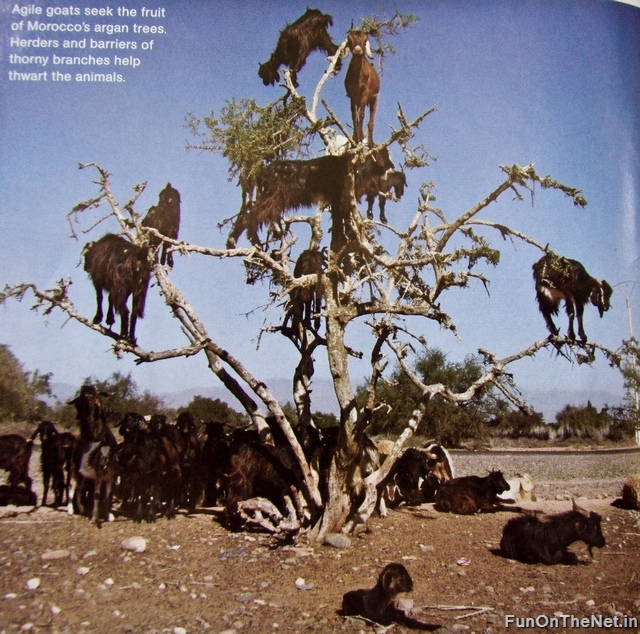
Goats on trees are found mostly only in Morocco. The goats climb them because they like to eat the fruit of the argan tree, which is similar to an olive. Farmers actually follow the herds of goats as they move from tree to tree. Not because it is so strange to see goats in trees and the farmers like to point and stare, but because the fruit of the tree has a nut inside, which the goats can't digest, so they spit it up or excrete it which the farmers collect. The nut contains 1-3 kernels, which can be ground to make argan oil used in cooking and cosmetics. This oil has been collected by the people of the region for hundreds of years, but like many wild and useful things these days, the argan tree is slowly disappearing due to over-harvesting for the tree's wood and overgrazing by goats.
Venezuela's Everlasting Storm

The mysterious "Relámpago del Catatumbo" (Catatumbo lightning) is a unique natural phenomenon in the world. Located on the mouth of the Catatumbo river at Lake Maracaibo (Venezuela), the phenomenon is a cloud-to-cloud lightning that forms a voltage arc more than five kilometre high during 140 to 160 nights a year, 10 hours a night, and as many as 280 times an hour. This almost permanent storm occurs over the marshlands where the Catatumbo River feeds into Lake Maracaibo and it is considered the greatest single generator of ozone in the planet, judging from the intensity of the cloud-to-cloud discharge and great frequency.
Honduras' Rain of Fishes

The Rain of Fish is common in Honduran Folklore. It occurs in the Departamento de Yoro, between the months of May and July. Witnesses of this phenomenon state that it begins with a dark cloud in the sky followed by lightning, thunder, strong winds and heavy rain for 2 to 3 hours. Once the rain has stopped, hundreds of living fish are found on the ground. People take the fish home to cook and eat them. Since 1998 a festival known as "Festival de la Lluvia de Peces" (Rain of Fish Festival) is celebrated every year in the city of Yoro, Departamento de Yoro, Honduras.
Kerala's (extraterrestrial?) Red Rain

From 25 July to 23 September 2001, red rain sporadically fell on the southern Indian state of Kerala. Heavy downpours occurred in which the rain was coloured red, staining clothes with an appearance similar to that of blood. Yellow, green, and black rain was also reported.
Brazilian's longest wave on the Earth

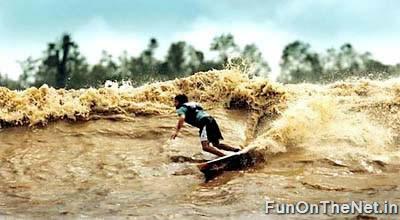
Twice a year, between the months of February and March, the Atlantic Ocean waters roll up the Amazon river, in Brazil, generating the longest wave on the Earth. The phenomenon, known as the Pororoca, is caused by the tides of the Atlantic Ocean wich meet the mouth of the river. This tidal bore generates waves up to 12 feet high which can last for over half an hour.


The wave has become popular with surfers. Since 1999, an annual championship has been held in São Domingos do Capim. However, surfing the Pororoca is especially dangerous, as the water contains a significant amount of debris from the margins of the river (often, entire trees). The record that we could find for surfing the longest distance on the Pororoca was set by Picuruta Salazar, a brazilian surfer who, in 2003, managed to ride the wave for 37 minutes and travel 12.5 kilometers. A surfer's dream: riding an almost never-ending wave.
Denmark's Black Sun

During spring in Denmark, at approximately one half an hour before sunset, flocks of more than a million European starlings (sturnus vulgaris) gather from all corners to join in the incredible formations shown above. This phenomenon is called Black Sun (in Denmark), and can be witnessed in early spring throughout the marshlands of western Denmark, from March through to the middle of April. The starlings migrate from the south and spend the day in the meadows gathering food, sleeping in the reeds during the night.
Idaho's Fire Rainbow

The atmospheric phenomenon known as a circumhorizon(tal) arc, or "Fire rainbow", appears when the sun is high in the sky (i.e., higher than 58° above the horizon), and its light passes through diaphanous, high-altitude cirrus clouds made up of hexagonal plate crystals. Sunlight entering the crystals' vertical side faces and leaving through their bottom faces is refracted (as through a prism) and separated into an array of visible colors. When the plate crystals in cirrus clouds are aligned optimally (i.e., with their faces parallel to the ground), the resulting display is a brilliant spectrum of colors reminiscent of a rainbow. The example shown above was captured on camera as it hung for about an hour across a several-hundred square mile area of sky above northern Idaho (near the Washington border) on 3 June 2006.
Friday, July 30, 2010
8000 Mile Trip By A Plastic Bottle Ship
Sailors hail the good ship 'Plastiki': Boat made from 12,500 plastic bottles completes 8,000-mile Pacific journey
Last updated at 12:35 PM on 26th July 2010
Green message: The 60ft-long Plastiki catamaran, built from plastic bottles, under the Sydney Harbour Bridge
Excited: Expedition leader David de Rothschild (second on left) and his crew
Long journey: The Plastiki completes her 8,000-nautical mile trans-Pacific voyage from San Francisco as she approaches the Sydney Opera House
British adventurer and environmentalist David de Rothschild sails as the Plastiki arrives at Sydney Harbour
'Trash to triumph': During their 128-day journey, the six-member crew lived in a cabin of just 20ft (6m) by 15ft (4.5m)
Divers next to the keel of the boat made from 12,500 plastic bottles
Facial Transplant
Facial Transplant
Face that doctors built: Gun accident victim shows off world's first full facial transplant
Last updated at 2:07 AM on 27th July 2010
Oscar, 31, underwent a full-face transplant in March. He appeared in public today for the first time at a news conference at the Vall d'Hebron Hospital in Barcelona, Spain
Oscar (centre) with his sister and Dr Joan Barrett at the press conference. He can now eat a soft food diet and is learning to speak again
Oscar stands beside Dr Joan Barret, left, and is surrounded by his doctors. He was treated by a team of 30 specialists
Before the operation: Oscar lost his nose in a hunting accident
Medical history: Dr Joan Pere Barret with X-rays showing the shattered face of the man prior to the operation
Quadruplets Survive
Quadruplets Survive
Fab 4 reunited: Quads back home after a six-month fight for their lives
By Claire Ellicott
They may look the picture of health, but this awesome foursome have spent six months fighting for their lives.This is the first time the quadruplets have been together since their birth in January. Gillian Holden, who defied odds of 750,000-1 to conceive them naturally, was diagnosed with pre-eclampsia during her pregnancy and doctors were forced to perform an emergency caesarean to deliver the babies when her organs began to fail.
Little fighters: The first time the quadruplets have been together since their birth in January. From left, Bethany, Millie, Ellie and Lucy.
The four were born at only 28 weeks in January and weighed just 7lb 6oz between them.
Doctors separated them at birth to give them specialist care for the first few months of their lives. They were reunited as a foursome after Ellie was allowed home at the weekend to join sisters Lucy, Millie and Bethany. The girls, three of whom are identical, are back with their delighted parents and older sister Abbie, aged nine, in Bolton. Miss Holden, a former nursery nurse, said: 'I'm absolutely over the moon - I couldn't be happier.
Happy family: Gillian Holden and Marc Hanley with their eldest daughter Abigail and (from left to right) Lucy, Bethany, Millie and Ellie after they all finally returned home, seven months since the quads were born
'It's been such a long wait and now all my babies are home.' Miss Holden, 35, had been trying for a baby with her partner Marc Hanley, 48, for nine months before she conceived. An 11-week scan showed triplets, but five weeks later doctors revealed there were actually four babies. She added: 'Initially, I was a bit upset. I thought, "How am I going to cope?" 'Marc was shocked, really shocked. But happy. I felt both scared and happy, lots of mixed feelings. 'When we came home we talked about it, comforted each other.' But the pregnancy did not run smoothly. Miss Holden soon became ill with pre-eclampsia and her kidney and liver began failing at 27 weeks, which meant the quads had to be delivered on January 28. Doctors had told her the tiny babies needed to make it to 28 weeks to survive.
Pictured: Gillian (left), Abigail and baby Lucy during one of the family's countless visits to the hospital to see the quads since they were born in January
Within three minutes, all four babies were delivered and placed in incubators at St Mary's Children's Hospital in Manchester. Bethany was the first to be born, arriving at 3.12pm on January 28, and weighing 1lb 15oz. Millie (2lb 2oz) and Ellie (1lb 7oz) arrived in the next minute. All three are identical, and Lucy, who throughout the pregnancy had been separated from her sisters by a tiny membrane, was born a minute later, weighing 1lb 14oz. Miss Holden said: 'All you could see were their faces, the size of a 10p piece. So tiny. 'That's all you see because they're covered up. They could have fitted in Marc's hand. We had visited the neonatal unit a couple of weeks before giving birth. We both cried, all the babies were so small and we were so scared.
Newborn: Baby Bethany (left) was born first weighing 1lb 15oz, with sister Millie next at 2lb 2oz
Tiny: Next to be born was baby Ellie weighing 1lb 7oz and last of all was Lucy who tipped the scales at 1lb 14oz
'They gave us the tour because they knew that's where our babies would end up.' Lucy was finally allowed home in May, and Bethany and Millie, who have chronic lung disease and require daily sessions on an oxygen generator, were discharged in June. But baby Ellie, who also has chronic lung disease, was forced to remain at Royal Bolton Hospital until last Friday as doctors helped her overcome her sleep apnoea. The babies were named by their sister Abbie. She said: 'Before, I didn't really have anyone to play with and now I have four sisters. 'I love them. I probably won't love them so much when I'm a teenager when they're getting into my makeup, but I'll always love them really.'
Beach- One Century ago
This collection of beach photos dates back to 1900-1920s. Modern beach is nothing like the beach on these black and white pictures.Popular Posts
-
The server request timed out "Sys.WebForms.PageRequestManagerTimeoutException: The server request timed out" Getting ...
-
Sunaina tamil Actress rds. Sunaina is an Indian film actress, who works in Tamil, Telugu, Kannada and Malayalam film industries. Her de...