Wednesday, July 21, 2010

10 Unique Laptops

10 Unique Laptops

Here are 10 really unique and cool laptops. From a dual screen laptop, to a split keyboard laptop to even a million dollar laptop!
 10 Unique Laptops


The Million Dollar Laptop
Unique Laptops

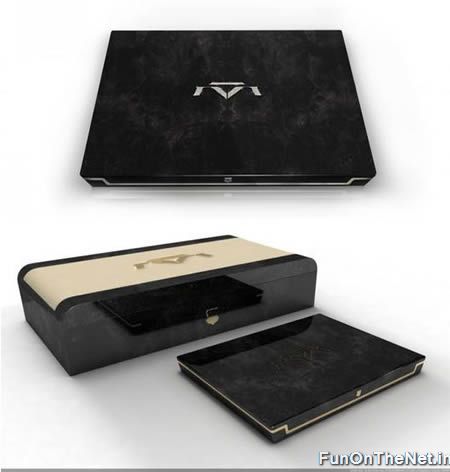
UK-based bespoke luxury goods creator Luvaglio has created the first million dollar laptop. That's what the first of their luxury laptops will sell for. Full details of the laptop have not been released at this point, but it is known that it incorporates a 17" wide LED lit screen with a specially designed anti-reflective glare coating for clear and brighter image, 128GB of Solid State Disk space and a slot loading Blue-Ray drive. There is an integrated screen cleaning device and a very rare coloured diamond piece of jewellery that doubles up as the power button when placed into the laptop, and also acts as security identification.

Orkin's Rolltop
Unique Laptops

The Orkin Design Rolltop would definitely be an item in the must-have list of most geeks, even if it is but a concept at point of publishing. Why do we say so? This "notebook" comes with a flexible OLED display which also handles multitouch for those who are head over heels with the iPhone. When fully rolled out, it ends up as a 17" flatscreen display but can also be folded into a 13" tablet when required. No idea on whether it will run on wireless power or not, but it seems as though the detachable stand will hold the tablet's stylus, power adapter and USB ports.
Datamancer's Steampunk Laptop
Unique Laptops

This may look like a Victorian music box, but inside this intricately hand-crafted wooden case lives a Hewlett-Packard ZT1000 laptop that runs both Windows XP and Ubuntu Linux. It features an elaborate display of clockworks under glass, engraved brass accents, claw feet, an antiqued copper keyboard and mouse, leather wrist pads, and customized wireless network card. The machine turns on with an antique clock-winding key by way of a custom-built ratcheting switch made from old clock parts.

Thinkpad Reserve Edition
 Unique Laptops
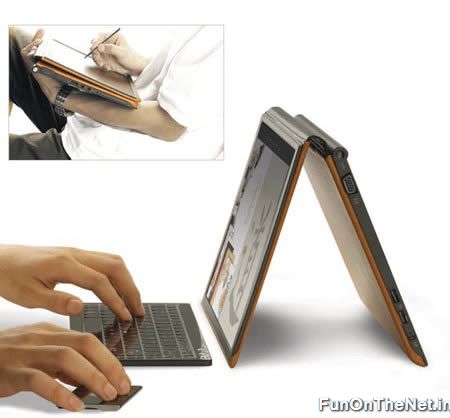
When IBM handed all of their laptop division to Lenovo, many feared that the classic Thinkpad design would lose its way, but with this improved design most of the people would be impressed by the laptop concept.

Ergonomic Dual Screen Split Keyboard Laptop

Unique Laptops
The sweetness of this amazing Ergonomic Dual Screen Split Keyboard Notebook Portable Personal Computer isn't only the fact that the keyboard splits open to give a computer user more room to fit their hands, but that it has a second LCD hidden underneath it. What a fantastic idea. The second screen works in concert with the first screen – giving the user a “drag and send” capability for open windows or programs, or act independently as a pen-based input screen for note taking, sketching, and just about anything else a user can do to write into the interface. This makes the EDSSKN of tremendous benefit to not only writers and word processors, but artists and designers as well.

HP Girly Laptop
Unique Laptops
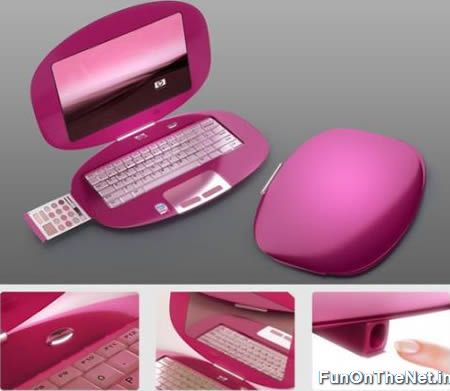
Some girls want the extra attention not only from men but also from actual gadgets and even cool looking laptops, such as these HP concepts made especially for women. Each one of these designs by Nikita Buyanov has its own set of specific that would recognize special pampering that a girl wishes for; they are classy looking, stylish, trendy and even provide extra productivity for your personality. Unfortunately they have yet to be truly manufactured, but if enough would show interest, maybe next year's HP models would provide a different feminine look that is made just for women.

Canova's Dual-Screen Laptop
Unique Laptops
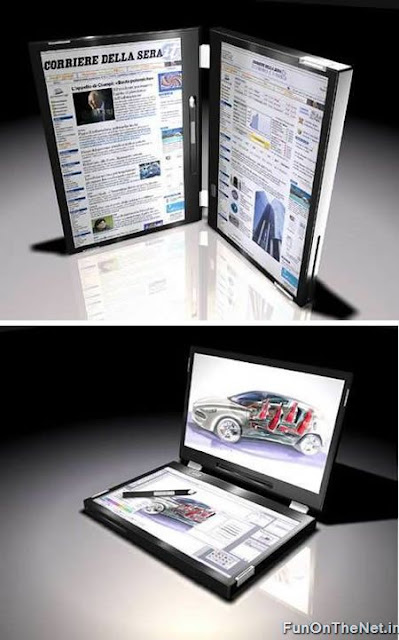
This Dual Touch Screen Laptop from Canova is an ultimate notebook design meant for the creative mind. The notebook features dual display with touch-sensitive screens, sketch pad, music score, graph paper, an electronic pen and a dedicated hardware for its smooth functioning. Unfortunately, it's only sold in Italy and Australia.

Fujitsu's DJ Laptop

Unique Laptops
Fujitsu DJ laptop, as it was called, has a 20-inch primary LCD display easily folded closed to enable the turntable function, which can be accessed via a touch-sensitive screen on the outside. The laptop lets you browse all your favorite tracks same as on a vinyl turntable.
TYPE-N01 Emergency Laptop
Unique Laptops

NEC has teamed up with Takara to create the presumably mad scientist-approved machine, which sports all the token stickers, labels, and even wallpapers that make this device so similar to those seen laying around Duke Nukem laboratories. Beneath the facade is a LaVie G type L laptop, 15.4-inch display. Flanked on the side is the very necessary "Emergency Button," which apparently shuts down the machine in case of unexpected intruders. Launched in 2006, only 300 units of the highly secretive TYPE-NO1 were made costing up to ¥174,510 ($1,476).

2015 Compenion Laptop
Unique Laptops
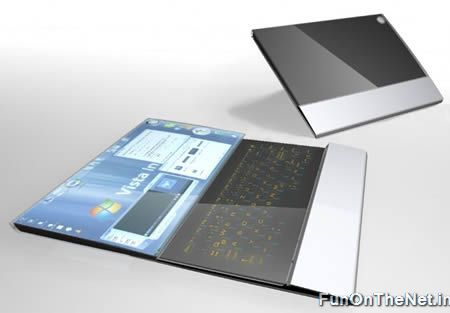
Felix Schmidberger design for a laptop for 2015 with OLED touch screen. The computer itself has an OLED touchscreen, where you can directly work on, much like with a umpc or pda. The whole screen is a slider, as it can be moved forward to reveal a secondOLED touchscreen underneath, where you can have a keyboard or working controls, similar to a setup with 2 monitors.

Tuesday, July 20, 2010

Remembering Apollo 11

Remembering Apollo 11

40 years ago, three human beings - with the help of many thousands of others - left our planet on a successful journey to our Moon, setting foot on another world for the first time. Tomorrow marks the 40th anniversary of the July 16, 1969 launch of Apollo 11, with astronauts Neil A. Armstrong, Michael Collins and Edwin E. "Buzz" Aldrin Jr. aboard. The entire trip lasted only 8 days, the time spent on the surface was less than one day, the entire time spent walking on the moon, a mere 2 1/2 hours - but they were surely historic hours. Scientific experiments were deployed (at least one still in use today), samples were collected, and photographs were taken to document the entire journey. Collected here are 40 images from that journey four decades ago, when, in the words of astronaut Buzz Aldrin: "In this one moment, the world came together in peace for all mankind". ("40 photos total)


The view from the Apollo 11 Command and Service Module (CSM) "Columbia" shows the Earth rising above the Moon's horizon on July 20th, 1969. The lunar terrain pictured is in the area of Smyth's Sea on the nearside. (NASA)


#photo2
German scientist Dr. Wernher von Braun explains the Saturn Launch System to President John F. Kennedy during a visit. NASA Deputy Administrator Robert Seamans is to the left of von Braun. (NASA) #photo2">#


#photo3
Astronaut Neil Armstrong on a one-day Gemini VIII mission in March of 1966. Gemini was a stepping-stone project, working toward the upcoming Apollo missions. (NASA/Space Frontiers/Getty Images) #photo3">#


#photo4
Astronaut Neil Armstrong, Apollo 11 mission commander, floats safely to the ground after an accident during a training session on May 6th, 1968. The Lunar Landing Research Vehicle (LLRV) exploded only seconds before while Armstrong was rehearsing a lunar landing at Ellington Air Force Base near the Manned Spacecraft Center (MSC). This photo is an enlargement of a frame from a 16mm documentary motion picture recorded during the mishap. (NASA) #photo4">#


#photo5
Neil Armstrong (left) watches Buzz Aldrin take a documentary photo of a sample during a training session on February 24th, 1969. (NASA) #photo5">#


#photo6
Michael Collins works in a Command Module simulator (with an assistant beside him). (NASA) #photo6">#


#photo7
Neil Armstrong poses for a photograph at the Lunar Landing Research Facility at NASA Langley in Virginia on February 12, 1969. (NASA) #photo7">#


#photo8
An official NASA portrait of astronaut Buzz Aldrin. (NASA) #photo8">#


#photo9
An aerial view of the 363 foot-tall (111 m) Apollo 11 Saturn V rocket rollout from the Kennedy Space Center's Vehicle Assembly Building in Florida on May 20th, 1969. (NASA) #photo9">#


#photo10
The Apollo 11 crew and Donald K. "Deke" Slayton look over charts during the traditional launch day breakfast of steak and eggs on July 16, 1969. (NASA) #photo10">#


#photo11
A technician works atop the white room, through which the astronauts will enter the spacecraft, while other technicians look on from the launch tower at the Kennedy Space Center in Florida on July 11, 1969. (NASA) #photo11">#


#photo12
Every console was manned in firing room 1 of the Kennedy Space Flight Center (KSC) control center during the launch countdown for Apollo 11. (NASA). #photo12">#


#photo13
Lift-off of the Saturn V rocket, carrying astronauts Neil Armstrong, Michael Collins, and Edwin "Buzz" Aldrin Jr, along with 6,700,000 pounds (3,039,000 kg) of fuel and equipment into the Florida sky, bound for the Moon, on July 16th, 1969. (NASA) #photo13">#


#photo14
A 70mm Airborne Lightweight Optical Tracking System (ALOTS) camera, mounted in a pod on a cargo door of a U.S. Air Force EC-135N aircraft photographed this event in the early moments of the Apollo 11 launch. The mated Saturn V second and third stages pull away from the expended first stage. Separation occurred at an altitude of about 38 miles, some 55 miles downrange from Cape Kennedy. (NASA) #photo14">#


#photo15
A view of Earth from orbit shortly after launch, July, 1969. (NASA) #photo15">#


#photo16
Lunar module pilot Edwin "Buzz" Aldrin, inside the module as it makes its way toward the Moon, July, 1969. (NASA) #photo16">#


#photo17
Looking back over their shoulder, an Apollo astronaut takes a photograph of the Earth during the long translunar coast. The body and some thruster nozzles of the Lunar Module are visible in the foreground. (NASA) #photo17">#


#photo18
Most of Africa and portions of Europe and Asia can be seen in this photograph taken from the Apollo 11 spacecraft during its translunar coast toward the moon. Apollo 11 was already 98,000 nautical miles from Earth when this picture was made on July 17th, 1969. (NASA) #photo18">#


#photo19
Arriving and entering into Lunar orbit. Seen below are craters Sabine and Ritter, and mountains stretching back to the horizon on July 19th, 1969. (NASA) #photo19">#


#photo20
Looking down at the Command and Service Module (center), with the Moon's surface below, as seen from the now-separated Lunar Module (LM), on its way to the surface. The proiminent crater is Schmidt crater. This is the last photo taken from the LM prior to the powered descent, and eventually the landing one orbit later. (NASA) #photo20">#


#photo21
Television footage of the first human footstep on Lunar soil on July 20, 1969. Astronaut Neil Armstrong took these first steps, followed shortly by Buzz Aldrin. This is a reproduction of the television image that was transmitted to the world on July 20th, 1969. (NASA) #photo21">#


#photo22
A close-up view of astronaut Buzz Aldrin's boot and bootprint in the lunar soil, photographed with a 70mm lunar surface camera during the Apollo 11 lunar surface extravehicular activity (EVA) on July 20th, 1969. (NASA) #photo22">#


#photo23
Astronaut Buzz Aldrin on his way to the Lunar surface for the LM on July 20th, 1969. (NASA) #photo23">#


#photo24
Buzz Aldrin took this picture of Neil Armstrong in the cabin after the completion of the first EVA. This is the face of the first man to set foot on the Moon, just hours earlier, on July 20th, 1969. (NASA) #photo24">#


#photo25
From Wikipedia contributor Rufus330Ci: "This is a picture of my mother holding the Washington News Paper on Monday, July 21st 1969 stating 'The Eagle Has Landed Two Men Walk on the Moon'. The photo was taken by my grandfather Jack Weir (1928-2005)" #photo25">#


#photo26
During their 2 1/2 hour EVA, Astronauts deployed a number of science experiments. Here, Buzz Aldrin is seen carrying the Laser Ranging Retroreflector Experiment (LRRR) and a seismometer to measure Moonquakes. (NASA) #photo26">#


#photo27
Close-up of the north footpad of the Lunar Module, with some lunar soil piled up beneath, evidence of a tiny amount of drift during the landing. (NASA) #photo27">#


#photo28
Astronaut Buzz Aldrin, photographed by Neil Armstrong (visible in reflection). Buzz Aldrin: "As I walked away from the Eagle Lunar Module, Neil said 'Hold it, Buzz', so I stopped and turned around, and then he took what has become known as the 'Visor' photo. I like this photo because it captures the moment of a solitary human figure against the horizon of the Moon, along with a reflection in my helmet's visor of our home away from home, the Eagle, and of Neil snapping the photo. Here we were, farther away from the rest of humanity than any two humans had ever ventured. Yet, in another sense, we became inextricably connected to the hundreds of millions watching us more than 240,000 miles away. In this one moment, the world came together in peace for all mankind." (quoted with permission from Apollo Through the Eyes of the Astronauts). (NASA) #photo28">#


#photo29
Post-deployment documentation photo of the Laser Ranging Retroreflector Experiment (LRRR). For the past 40 years, the retroreflectors were used in conjunction with a dedicated facility at the McDondald Observatory in Texas to accurately measure the distance to the Moon. These experiments discovered, among other things, that the moon is moving away from Earth at a rate of 2.5 inches per year. The National Science Foundation recently terminated funding for the McDonald Laser ranging station, with continued measuements to be made by two other facilities. (NASA) #photo29">#


#photo30
View of Earth above the Lunar Module on July 20th, 1969. (NASA). #photo30">#


#photo31
Interior view of the Mission Operations Control Room (MOCR) in the Mission Control Center (MCC), Building 30, during the Apollo 11 lunar extravehicular activity (EVA). The television monitor shows astronauts Neil A. Armstrong and Edwin E. Aldrin Jr. on the surface of the moon, July 20, 1969. (NASA) #photo31">#


#photo32
Panorama of the view out Buzz Aldrin's window over the thrusters after the EVA. (NASA) #photo32">#


#photo33
A memorial plaque, attached to a leg of the Lunar Module. The plaque reads: "Here Men From The Planet Earth First Set Foot Upon the Moon, July 1969 A.D. We Came in Peace For All Mankind." (NASA) #photo33">#


#photo34
A bright halo around the shadow of Buzz Aldrin's helmet, the sun directly behind his head. (NASA) #photo34">#


#photo35
After lifting off from the Moon, Eagle approaches the Command Module during rendezvous. Astronaut Michael Collins, who remained on board the Command Module for the entire trip, remembers taking this photograph: "Little by little, they grew closer, steady, as if on rails, and I thought 'What a beautiful sight,'one that had to be recorded. As I reached for my Hasselblad, suddenly the Earth popped up over the horizon, directly behind Eagle. I could not have staged it any better, but the alignment was not of my doing, just a happy coincidence. I suspect a lot of good photography is like that, some serendipitous happenstance beyond the control of the photographer. But at any rate, as I clicked away, I realized that for the first time, in one frame, appeared three billion earthlings, two explorers, and one moon. The photographer, of course, was discreetly out of view." (quoted with permission from Apollo Through the Eyes of the Astronauts) (NASA) #photo35">#


#photo36
This view of the whole full moon was photographed from the Apollo 11 spacecraft during its trans-Earth journey homeward. When this picture was taken, the spacecraft was already 10,000 nautical miles away, on July 21st, 1969. (NASA) #photo36">#


#photo37
A black and white photograph of the Earth taken during the trip home from the Moon. (NASA) #photo37">#


#photo38
Apollo 11 crew and a Navy diver await pickup after a safe splashdown east of Wake Island in the Pacific Ocean on July 24th, 1969. (NASA) #photo38">#


39
Astronauts Armstrong, Collins, and Aldrin (left to right) in their isolation van on-board the recovery ship U.S.S Hornet are greeted by U.S. President Richard M. Nixon on July 24th, 1969. (NASA) #photo39">#


#photo40
New York City welcomes Apollo 11 crewmen in a showering of ticker tape down Broadway and Park Avenue in a parade termed as the largest in the city's history on August 13, 1969. Pictured in the lead car, from the right, are astronauts Neil A. Armstrong, commander; Michael Collins, command module pilot; and Edwin E. "Buzz" Aldrin Jr., lunar module pilot. (NASA) #photo40">#

How to create Custom Meta Tags and Title Tags for Blogger Blog

How to create Custom Meta Tags and Title Tags for Blogger Blog :

Edit this bellow piece of HTML code and paste into your blogger html Source code,exactly bellow to the Header section  <head>.

Use this bellow HTML meta tags Code for Your Blog Home Page only,Never change this code and use this for one time only...

<b:if cond=’data:blog.pageType == &quot;item&quot;’>

<title><data:blog.pageName/> | <data:blog.title/></title>

<b:else/>

<title><data:blog.pageTitle/></title>

</b:if>

<b:if cond=’data:blog.url == data:blog.homepageUrl’>

<meta content=’This place is for your blog home page description‘ name=’description’/>

<meta content=’keyword1,keyword2,keyword3,keyword4,keyword5,keyword6,keyword7,keyword7, keyword8‘ name=’keywords’/>

</b:if>

Use this bellow HTML Meta tags code for you Blog Post,you have to create new code every time when you create a new article….

<b:if cond=’data:blog.url == &quot;http://yourdomain.blogspot.com/yourblog-post-url&quot;’>

<meta content=’This place for your Blog post description’ name=’description’/>

<meta content=’keyword1,keyword2,keyword3,keyword4,keyword5,keyword6,keyword7,keyword7, keyword8‘ name=’keywords’/>

</b:if>

Replace the blue text with your own Keywords and Description,and paste it in your blogger HTML Header section.So from this time whenever you post a new article,just change the second code with your own Article URL,keywords and description.

Popular Posts